 EN

When specifying alumina for long afterglow phosphors (the SrAl₂O₄:Eu²⁺, Dy³⁺ strontium aluminate system), the question purchasing teams ask most often is simple: what is the actual difference between 3N and 4N/5N alumina? Our measured reports for both grades put the impurity profile and the particle size distribution side by side, so the answer can be given in one go.
What the data shows for 3N5 and 4N5
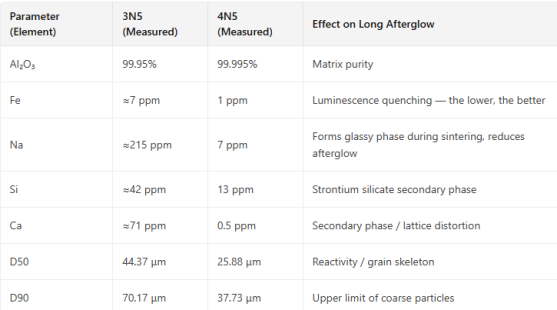
1. Main content. 3N5 = Al₂O₃ ≥ 99.95%; 4N5 = Al₂O₃ ≥ 99.995%. But the headline purity figure is not the real difference. What matters is the control level for the elements that cause luminescence quenching and glassy phase formation — Na, Fe, Si and Ca — together with the particle size range.
2. Impurity profile. 4N5 sits one to two orders of magnitude lower than 3N5 on both Na and Ca.
3. Particle size distribution.
The 3N5 grade runs coarser with a strong grain skeleton and good flowability, and its conversion rate with SrCO₃ is high — which is why it suits products built around a "bone". The 4N5 grade is finer with a narrower band and higher surface activity, which is what fine-grained luminous surfaces require.
What afterglow producers should actually look for in an alumina supplier
Price is not the deciding factor, and neither is the highest possible purity. Four things matter, in this order.
First, batch-to-batch stability. Long afterglow powder is a formulation-driven product. If Fe drifts by a few ppm, or D50 shifts by a few microns, an entire furnace load drops a brightness grade. What customers fear most is a good batch followed by a poor one — the loss from scrapping one furnace runs to dozens of times the price difference on the raw material.
Second, Fe and Na must sit inside the customer's formulation window on every batch COA. Not as low as possible — as predictable as possible.
Third, particle size must be adjustable to the finished product. Fine powder for luminous powder, coarse for aggregate, coarser still for precast elements. Whether a supplier can adjust the size curve to order matters far more than a spot price that is a couple of hundred yuan cheaper.
Fourth, every batch should ship with both XRF and laser particle size reports, with retained samples available for retesting. And when pinholes, short afterglow or dark cores appear, the supplier should be able to join a retest of the same batch, or arrange a batch replacement, within 24 hours.
How Greatsun Aopeng works
Every bag is inspected. Every batch is held against the standard sample specifications. Customer requests get a first-time response. Samples ship with the measured report for that batch, and the COA can be matched directly at the time you request the sample.
